




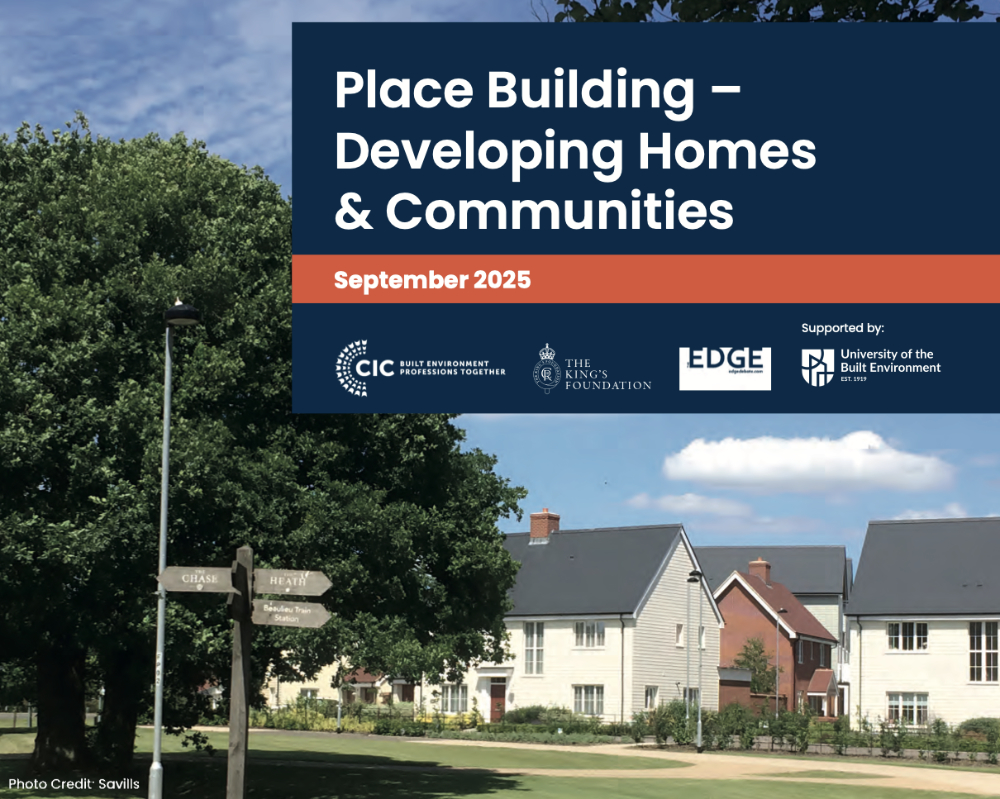
Place Building. Developing Homes and Communities. A summary report from a University of the Built Environment event
Contents |
[edit] Introduction
This report is from the recently established University of the Built Environment,( see UCEM becomes the University of the Built Environment) following its event of the same name. The ‘Place Building – Developing Homes & Communities’ event brought together experts to explore how people-centred, mixed-use developments create vibrant communities, highlighting evidence-led place making and long-term benefits.
This comes at a key time from many perspectives, for example such as the planning overhaul to reach 1.5 million new homes, and the building new towns for the future the interim report of the New Towns Taskforce. Through partnerships with Savills, The King’s Foundation, and The Stewardship Initiative, the University showcased research, practical innovation, and policy insight, aiming to inspire the sector to adopt holistic, sustainable approaches to building better homes and communities. In the forward Ashley Wheaton HonRICS, UCEM Vice Chancellor of University of the Built Environment outlines how the new university is responding to the challenges of the industry through cross sector programmes equipping the next generation of students.
Below is a precis of the report, to download the full report for free follow this UBE link.
[edit] Speakers and panel members
Dr Wei Yang emphasised that England’s housing crisis requires a strategic, place-based approach integrating health, wellbeing, and climate priorities, supported by interdisciplinary collaboration and digital technology, rather than one-size-fits-all solutions.
Dr William Bird highlighted that thoughtfully designed communities—with accessible green spaces, walkability, and opportunities for social interaction—significantly improve residents’ health, wellbeing, and social cohesion.
Dan Hill reported that a study of 71 UK housing developments found that higher ‘place scores’—reflecting green spaces, community amenities, retail, and master planning—correlated with better resident outcomes, including lower child obesity, fewer hospital admissions, reduced crime, and improved educational performance.
Ben Bolgar presented the Regional Building Hub model, designed to help smaller builders scale up and adopt a place-building approach, creating diverse, walkable communities unlike typical volume housebuilder developments, while addressing challenges such as planning delays, limited land access, and funding constraints.
Gail Mayhew advocated for a long-term, patient-capital approach to housing, proposing a ‘master developer’ model where landowners act as equity partners, supported by regional partnerships, tax incentives, and institutional investment, citing examples like Nansledan to demonstrate improved community outcomes.
Dr Graeme Larsen chaired a panel on implementing place building, highlighting the key challenge of securing early financing for essential infrastructure to create thriving communities.
Robin Nicholson emphasised that the current economic model is flawed, with the separation of infrastructure and building financing posing a greater challenge than planning itself.
Dr Elanor Warwick highlighted the importance of investing in both physical and social infrastructure, urging support for community initiatives and organisations that provide accessible activities and amenities, essential for genuine community building.
[edit] Key outcomes
[edit] Emerging Evidence Base For Place Building
Emerging research data shows that well-planned developments with quality green spaces, community amenities, retail, and strong master planning can reduce crime, improve health, and enhance education. Though the evidence base is still growing, it strongly supports prioritising place building in policy and practice, offering long-term social value and making a compelling case for investment.Importance Of A Holistic Approach To Planning Communities
[edit] Importance Of A Holistic Approach To Planning Communities
The successful place building goes beyond housing numbers, focusing instead on integrating health, wellbeing, and education into development plans. Contributors stressed the importance of holistic planning, urging collaboration between developers, planners, local authorities, and service providers to ensure communities have the services and opportunities needed to thrive. A key takeaway was the call to rethink infrastructure, not just as physical assets but as a means to enhance community life and sustainability. The discussion also underscored the vital role of social infrastructure—such as communal spaces, networks, and community programmes—which must be established from the moment residents move in to build strong, resilient communities.
[edit] Tax Reforms Needed To Unlock Large-Scale Place Building
Current tax rules make long-term, holistic place making financially difficult, discouraging large-scale investment. Targeted reforms could help, such as land pooling tax relief, which would defer Capital Gains Tax and Stamp Duty until homes are sold, reducing upfront costs for landowners working together. Another proposal is eliminating double taxation in partnerships by allowing pass-through taxation and exempting initial land transfers into joint ventures, ensuring profits are only taxed once. These low-cost reforms focus on deferring or removing barriers that currently hinder development, enabling more collaborative and large-scale community building.
[edit] Regional Building Hubs Can Catalyse Nationwide Place Building
The Regional Building Hubs (RBH) model offers a way to empower small and medium-sized builders to deliver sustainable, community-focused developments. By combining physical and digital platforms, RBHs bring together local builders, landowners, suppliers, and communities to collaborate, share expertise, and access regional planning support. This helps smaller enterprises overcome capacity and knowledge barriers, enabling them to adopt place building principles often overlooked by large volume housebuilders. Scalable and replicable, the RBH model could form a nationwide network, tailored to local needs but connected through a shared digital platform for knowledge exchange.
[edit] Community Engagement Is Essential For Effective Place Design
Placing communities at the centre of design is key to creating successful developments. Genuine engagement throughout the process fosters pride, ownership, and ensures that new places reflect local character and needs. Moving beyond traditional consultation, active participation—through tools like community-led workshops and collaborative charrettes—gives residents, businesses, and civic groups meaningful influence over design from the outset, leading to more authentic and resilient outcomes.
[edit] Related articles on Designing Buildings
- Apprenticeships.
- ARB.
- Architecture.
- Ashley Wheaton HonRICS, UBE Vice Chancellor.
- Built environment.
- Construction
- Elements of the built environment.
- Guest Editor Programme in the first six months.
- Masterplanning.
- Planning.
- Real estate.
- Sustainability in construction: Knowledge hub.
- Transforming Professional practical experience for Architects in training.
- UCEM becomes the University of the Built Environment.
- University College of Estate Management.
- Urban design.
- Ashley Wheaton HonRICS, UBE Vice Chancellor
Featured articles
Check out some of the best features and news from Designing Buildings as well as key stories from around the web.

Government approach could undermine delivery and regeneration.
World's first mass timber data centre.

The overlooked environmental aspect of data centre development.
Introduction to radon awareness

New technical information sheet published by CIOB.

Updated supplier guide can help electrical contractors engage with NHP.

CIAT confirm the winners of the 2026 architectural technology awards.

Government launches a one stop shop for flood preparedness.

Sir Edwin Lutyens: Britain's greatest architect? Book review.

CIOB publishes free template to help assess and manage risks.
ECA's reflections on Party Conference season

Burnham wants to be confident of winning before asking for a fresh mandate.
New Chief Construction and Scientific Adviser

Sergio Cavalaro, Professor of Infrastructure Systems at Loughborough University.
Building safety levy for England

CIAT publish estimator tool for members.

Water sector faces a growing crisis that could slow the delivery of vital infrastructure.